Northern Bukovina, in western Ukraine, is often described as one of the country’s most diverse and outward-looking regions. Centered on Chernivtsi — a city close to the borders of Romania and Moldova — it has long been shaped by overlapping languages, cultures, and histories.
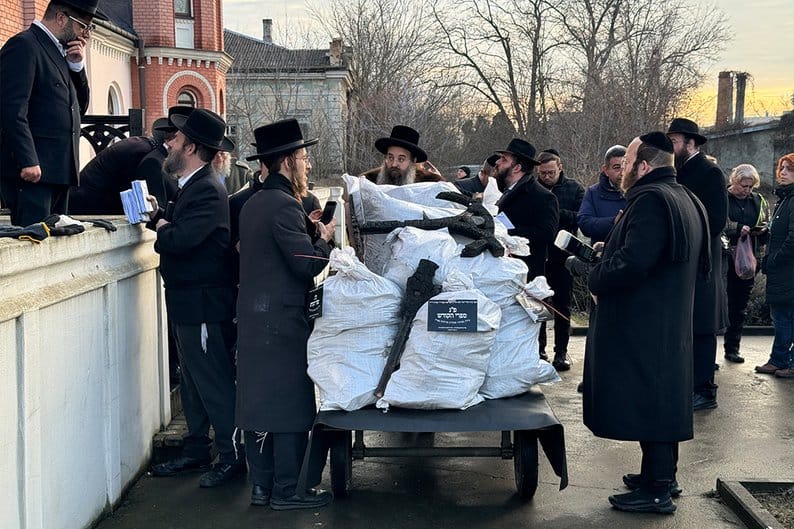
That reputation for calm was badly shaken on the evening of November 27, 2025, when one of Chernivtsi’s most important Hasidic places of worship was set on fire: the historic synagogue in Sadigura (also known as Sadgora/Sadhora). The blaze caused significant damage to the building. No one was reported injured.
Police: no antisemitic motivation
According to sources from the local Jewish community and the regional police, the alleged perpetrator is a man described as living with serious mental health conditions, who had previously attempted to cause similar incidents in the city but failed.
The Chief Rabbi of Chernivtsi, Menachem Mendel Glitzenstein, told Ukrainian media the incident deeply shocked the community — but said it was not connected to the rise in antisemitism seen in many parts of the world.
“We have not felt the increase in hatred. We are protected, and the residents of Chernivtsi live in peace.”
Chernivtsi police confirmed to Unsustainable Magazine that the incident did not have an antisemitic motivation, while noting they remain in close contact with representatives of the Jewish community.
A building with deep Hasidic history
The synagogue is tied to the Ruzhin–Sadigura dynasty — a major 19th-century Hasidic movement whose influence spread far beyond Bukovina. The site has been widely recognized as part of Europe’s Jewish heritage, and is associated with pilgrimage and religious life even amid the disruptions of war.
Learn more about the Sadigura synagogue’s history from Jewish Heritage Europe, and reporting on the incident from The Jerusalem Post and The Times of Israel.

“Very safe”: refugees describe life in Chernivtsi
Since Russia’s full-scale invasion began, Chernivtsi has become a major hub for people displaced from the east and south of Ukraine. Its distance from the front lines, combined with strong cross-border connections, has helped it remain a place where many families attempt to rebuild daily life — even as air raid sirens and news from the front remain constant.
Several Jewish and Ukrainian internally displaced people in Chernivtsi told Unsustainable Magazine they still consider northern Bukovina to be a “very safe” region, and say its multicultural identity has only deepened with the arrival of new residents from other parts of the country.
Max Brodsky, an ethnic Jewish refugee from Mariupol, said he never felt — either before or after the invasion — that being Jewish in Ukraine was dangerous.
“My family and I moved from Mariupol, which was completely destroyed by the Russians, here in Chernivtsi. We are here, but our hearts are there… Israel is our homeland, but Ukraine is our home. We are trying to be strong. We consider the region where we are located to be very peaceful… All we want is for the world not to abandon us.”
Liza Kozatska, originally from the Russian-occupied part of the Zaporizhzhia region, said Chernivtsi gave her a kind of stability she did not think she would find during wartime — even though air raid alarms still trigger memories of occupation.
“We moved with my family in 2023. We lived for a few months under the Russian occupation… In Chernivtsi I entered the University. We like the city because it is very diverse… I think it is a blessing that we got here… I think about our friends and relatives in Zaporizhzhia and Kherson. I always tell them that they are heroes for staying.”
War reaches “safer” regions, too
While western Ukraine has often been seen as comparatively secure, the wider region has not been untouched by the war’s escalating reach. In July 2025, Chernivtsi city suffered civilian casualties during a Russian strike — a reminder that distance from the front line does not guarantee safety.
Even so, displaced families continue arriving in the region. UN agencies have repeatedly highlighted how western oblasts — including Chernivtsi — have shouldered the complex work of hosting and supporting people forced from their homes.

A test of solidarity — and resilience
The fire at the Sadigura synagogue landed as a shock not only because of the damage to a historic building, but because it touched a wider fear shared by many communities across Europe: that religious sites may become targets as war, displacement, and political extremism reshape public life.
In this case, local authorities say the incident was not driven by antisemitic intent. For residents and refugees alike, the priority now is recovery — restoring a sacred space, and preserving the fragile sense of normality that Chernivtsi still offers in a country at war.
About the author: Constantin Dicusar is a Moldovan journalist and historian whose reporting focuses on Eastern Europe, Ukraine, and regional geopolitics. His work has appeared in outlets including WhoWhatWhy, Daily Sabah, and Liga.net.