Plumbing is one of the least glamorous parts of a renovation, which is exactly why it deserves more attention than it usually gets. Cabinets, tiles, fixtures, and paint colours are visible every day. Pipes are not. But the material behind the wall can quietly determine whether a renovation remains low-maintenance for decades or becomes a source of leaks, water damage, emergency repairs, and avoidable waste.
Choosing between PEX, copper, and PVC is not really a question of which material is “best” in a general sense. It is a question of which material is right for the job, the location, the existing system, the local code, and the installer’s skill level. A pipe that performs well in one part of a home may be unsuitable somewhere else.
That distinction matters because durability is not only a financial issue. Working with an professionals like the team at PlumbingSell is essential. A poorly specified or badly installed plumbing system can waste treated water, damage building materials, and force premature replacement. The U.S. Environmental Protection Agency’s WaterSense program estimates that the average household’s leaks can waste more than 9,300 gallons of water each year. Choosing the right materials and fittings from the beginning is one practical way to reduce that risk.
Key Takeaways
- PEX, copper, and PVC are not interchangeable. PEX and copper are commonly used for pressurised water supply, while PVC is often used for drain, waste, and vent applications.
- The most durable choice depends on the application. Hot water, cold water, drainage, exposure, water chemistry, pressure, and local code all matter.
- Installation quality is as important as material choice. A good pipe installed badly can still leak, fail, or require premature replacement.
- Compatibility matters. Pipe type, fitting system, connection method, certification, and existing plumbing should all be checked before materials are ordered.
- Local rules come first. Plumbing and drainage work must meet the relevant building, plumbing, and product standards in your jurisdiction.
In Focus: Why Pipe Choices Matter
- Average household leaks can waste more than 9,300 gallons of water per year, according to EPA WaterSense.
- Across the United States, household leaks waste nearly 1 trillion gallons of water annually.
- In Australia and New Zealand, the AS/NZS 3500 plumbing and drainage standards support the safe and efficient design, construction, and maintenance of plumbing systems.
- PVC-U drain, waste, and vent pipes are commonly manufactured to standards such as AS/NZS 1260 for DWV applications.
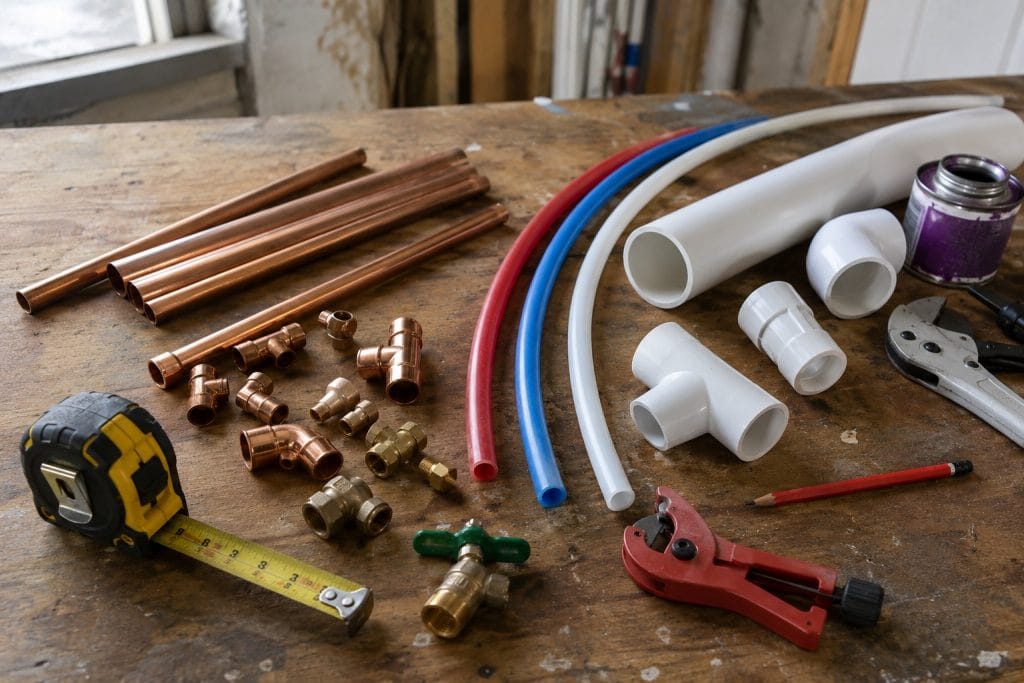
Start With the Job, Not the Material
One of the simplest ways to avoid plumbing mistakes is to begin with the system you are working on. Is the pipe carrying pressurised drinking water? Hot water? Wastewater? Vent air? Stormwater? Each of those jobs has different requirements.
PEX and copper are commonly used for hot and cold water supply lines. These are pressurised pipes that carry water to sinks, showers, toilets, dishwashers, washing machines, outdoor taps, and other fixtures. They need to be rated for the pressure, temperature, and potable-water requirements of the system.
PVC is different. In many residential renovation contexts, PVC is associated with drain, waste, and vent plumbing, often shortened to DWV. These pipes remove wastewater and help air move through the plumbing system so fixtures can drain properly. DWV plumbing is not simply “non-pressure pipe”; it also has slope, venting, sizing, and fitting-orientation requirements.
This is why choosing plumbing materials based only on diameter or appearance is risky. Two pipes may look similar on a shelf but be designed for very different uses. A renovation should begin with the purpose of the pipe, then move to the approved material and fitting system.
PEX: Flexible, Practical, and Not Invincible
PEX has become a popular choice for many residential water supply renovations because it is flexible, lightweight, and easier to route through tight spaces than rigid pipe. In a bathroom, kitchen, laundry, or utility-room update, that flexibility can reduce the number of fittings needed and make it easier to work around framing, joists, and awkward existing conditions.
For many homeowners, PEX is also less intimidating than copper. It does not require soldering, and its colour coding can make hot and cold water lines easier to identify. Red and blue PEX are often used for hot and cold lines, although the colour itself is not a substitute for checking the pipe’s rating and markings.
The main caution with PEX is that it is a system, not just a pipe. PEX-A and PEX-B are commonly discussed in renovation projects, but they often use different connection methods. PEX-A is commonly associated with expansion fittings, while PEX-B is commonly associated with crimp or clamp systems. The pipe, fittings, rings, sleeves, and tools need to match.
PEX also has exposure limits. Industry guidance commonly warns that PEX should be protected from prolonged ultraviolet exposure and is not generally intended for exposed outdoor use. That does not make it a poor material; it simply means it needs to be used where it is suitable and installed according to the manufacturer’s instructions.
For homeowners comparing pipe, fittings, valves, and connection options before speaking with a contractor, a plumbing supplier such as PlumbingSell can be useful for understanding how different systems fit together. The final choice, however, should still be checked against product certification, local code, and the specific conditions of the renovation.
Copper: Durable, Familiar, and Skill-Dependent
Copper has a long history in residential plumbing, and for good reason. It is rigid, durable, heat-resistant, and familiar to many plumbers and inspectors. In exposed areas, mechanical spaces, and neatly arranged service zones, copper can look orderly and professional. It can also be useful where a rigid pipe run is preferable to a flexible one.
Copper also has a strong recycling story compared with many single-use building materials. When it is removed from a building, it can often be recovered and recycled rather than treated purely as waste. That circularity is one reason copper remains attractive in discussions about durable construction materials.
That does not mean copper is automatically the best choice for every renovation. It is usually more expensive than PEX, can take longer to install, and may be harder to route through tight spaces. Traditional soldered copper joints require skill, preparation, heat, and care. Press fittings can reduce some of that labour, but they require compatible fittings and a suitable press tool.
Water chemistry can also matter. In some conditions, copper pipe may be affected by corrosion, pinhole leaks, or interactions with aggressive water. This is one reason local plumbing experience is valuable. A material that performs well in one region or water system may not have the same lifespan somewhere else.
Copper remains a strong option where its durability, rigidity, and heat tolerance are useful. But for DIY renovators, it is often less forgiving than PEX. Poorly prepared joints, rushed soldering, or incompatible transitions can undermine the very durability that made copper attractive in the first place.
PVC: Useful for Drainage, But Easy to Misunderstand
PVC is often the most familiar plastic pipe in home renovation, but it should not be treated as a universal plumbing material. In residential work, PVC is commonly used for drain, waste, and vent systems. That includes many sink drains, bathroom drains, vent pipes, and other non-pressure drainage applications.
For drainage, PVC has several practical advantages. It is lightweight, relatively affordable, easy to cut, and available with a wide range of elbows, tees, couplings, adapters, wyes, and other fittings. That makes it useful when plumbers need to build drainage layouts around framing, fixture positions, and renovation constraints.
The important distinction is that DWV plumbing has its own rules. Drain pipes need proper fall. Vents need to be placed correctly. Fittings need to be oriented for flow. A drainage system that is assembled from the wrong fittings or installed with the wrong slope can gurgle, drain slowly, clog more easily, or create odour and maintenance problems.
It is also important not to confuse standard PVC, pressure-rated PVC, CPVC, and DWV pipe. These products may look similar to non-specialists, but they are not all approved for the same jobs. Hot-water supply, potable-water supply, stormwater, and sanitary drainage may each require different materials and standards. The printed markings on the pipe, the manufacturer’s documentation, and the local plumbing code matter more than a visual guess.
Durability Is About the Whole System
A durable plumbing choice is not only about the pipe material. It is about the complete system: pipe, fittings, valves, supports, transitions, insulation, access, installation method, and the conditions around it.
PEX can be an excellent renovation material when protected from UV exposure, supported correctly, and connected with the proper fitting system. Copper can last for decades when water chemistry, installation quality, and joint preparation are right. PVC DWV systems can perform reliably when slope, venting, pipe size, and fitting orientation are correct.
The opposite is also true. The wrong fitting can compromise a good pipe. A hidden joint in an inaccessible wall can turn a minor mistake into an expensive repair. A poorly planned drain can create years of nuisance even if every individual part was technically new.
This is where sustainability and practicality overlap. The lowest-waste plumbing system is usually not the one with the most impressive material claim. It is the one that works safely, resists leaks, can be repaired when needed, and does not have to be ripped out early because it was poorly specified.
Compatibility Checks Before You Buy
Before ordering materials, slow down and identify the details that determine compatibility. Start with the existing pipe type and size. Then check whether the line is hot water, cold water, drainage, venting, or something else. After that, confirm the connection method.
PEX systems may use crimp, clamp, sleeve, or expansion connections depending on the pipe and fitting type. Copper may involve soldered, compression, threaded, push-fit, or press connections. PVC DWV systems often use socket fittings and solvent cement, but the correct fitting type and orientation still matter.
Transitions deserve special attention. Many renovation projects involve connecting new materials to older ones: copper to PEX, PVC to existing drainage, new fixture supplies to old valves, or modern fittings to older pipework. Those transitions often require specific adapters, and they should remain accessible where possible.
It is also worth checking product certification before buying. In Australia, for example, plumbing products commonly need to meet relevant WaterMark and National Construction Code requirements. The exact rules depend on the product, application, and jurisdiction, but the principle is simple: use approved materials for the job they are designed to do.
When DIY Is Reasonable and When It Is Not
Some plumbing tasks are more DIY-friendly than others. Replacing a visible trap under a sink is not the same as rerouting hot and cold water lines inside a wall. Installing a fixture supply hose is not the same as altering a drainage system. Even when a material is easy to cut and assemble, the system still needs to be safe, compliant, and serviceable.
PEX may be more approachable than soldered copper for many homeowners, but it still requires the correct tools, clean cuts, proper insertion depth, and compatible fittings. PVC may seem simple, but drains are sensitive to slope and venting. Copper may be durable, but soldering near timber, insulation, or existing finishes introduces fire and damage risks if the installer is inexperienced.
Licensed work rules vary by location, so homeowners should check what they are legally allowed to do before beginning. Even where minor DIY work is permitted, it is often wise to bring in a licensed plumber for concealed work, hot-water systems, major rerouting, drainage changes, or anything that could affect water safety or building insurance.
The Better Question: What Will Still Make Sense in 20 Years?
Good renovation choices are not only about getting through installation day. They are about what will still make sense after years of use, maintenance, and repairs.
A lasting plumbing system should be understandable to the next person who works on it. It should use recognisable materials and fittings. It should avoid unnecessary hidden joins. It should allow access to valves and service points. It should be protected from conditions that shorten its life, such as UV exposure, freezing, physical damage, poor support, or incompatible materials.
That mindset changes the way homeowners compare PEX, copper, and PVC. PEX may be the smartest choice for flexible water-supply runs in a difficult renovation space. Copper may be the better option where rigidity, heat resistance, or exposed neatness matters. PVC may be the obvious material for many DWV applications, provided the correct rated pipe and fittings are used.
There is no single winner because the real goal is not to choose the trendiest pipe. The goal is to build a plumbing system that suits the job, meets code, avoids leaks, and lasts long enough to justify the materials used.
Final Thoughts
PEX, copper, and PVC each have a place in home renovation. PEX is flexible and renovation-friendly for many water supply applications. Copper is durable, familiar, and heat-resistant, but usually requires more skill and labour. PVC is practical for many drain, waste, and vent systems, but it must be chosen and installed for the correct application.
The most sustainable plumbing choice is rarely a material in isolation. It is the material that fits the purpose, is approved for the job, is installed well, and can keep working without leaks or premature replacement. Before opening walls or ordering parts, identify the system, check the code requirements, confirm compatibility, and think about how the installation will be maintained years from now.
Plumbing that lasts is not always the most visible part of a renovation. But when it quietly does its job, protects water, and avoids wasteful repairs, it may be one of the most important choices in the whole project.