For decades, coastal development has followed a predictable pattern: clear the land, level the terrain, build for the view. The result has often been visually striking but environmentally fragile. In Costa Rica, a country defined by its biodiversity and conservation reputation, that model is increasingly being challenged. A new generation of architects and developers is rethinking what a beachfront villa should be: not an imposition on the landscape, but an extension of it.
Of course, even carefully designed beachfront property still carries environmental pressure. The question is not whether luxury coastal development can be impact-free, but whether it can be made less damaging, more resilient, and more responsive to the ecosystems around it. In sensitive coastal settings, that distinction matters.
From Domination to Integration
Traditional beachfront construction tends to prioritize immediate aesthetics over long-term sustainability. Large glass facades facing the ocean, expansive air-conditioned interiors, and heavily altered terrain are common features. While appealing on the surface, these choices can increase energy consumption, worsen erosion risks, and disrupt local ecosystems.
The emerging approach shifts the question entirely: instead of asking how to build on the coast, designers are asking how to build with it. This means respecting natural contours, preserving vegetation, and understanding microclimates before breaking ground. The coastline is treated not as a blank canvas, but as a complex, living system.
That approach is especially important in Costa Rica, where beachfront property is shaped not only by environmental realities but also by coastal land-use rules. The country’s Maritime Terrestrial Zone, for example, affects how land near the shoreline can be occupied, leased, and developed.
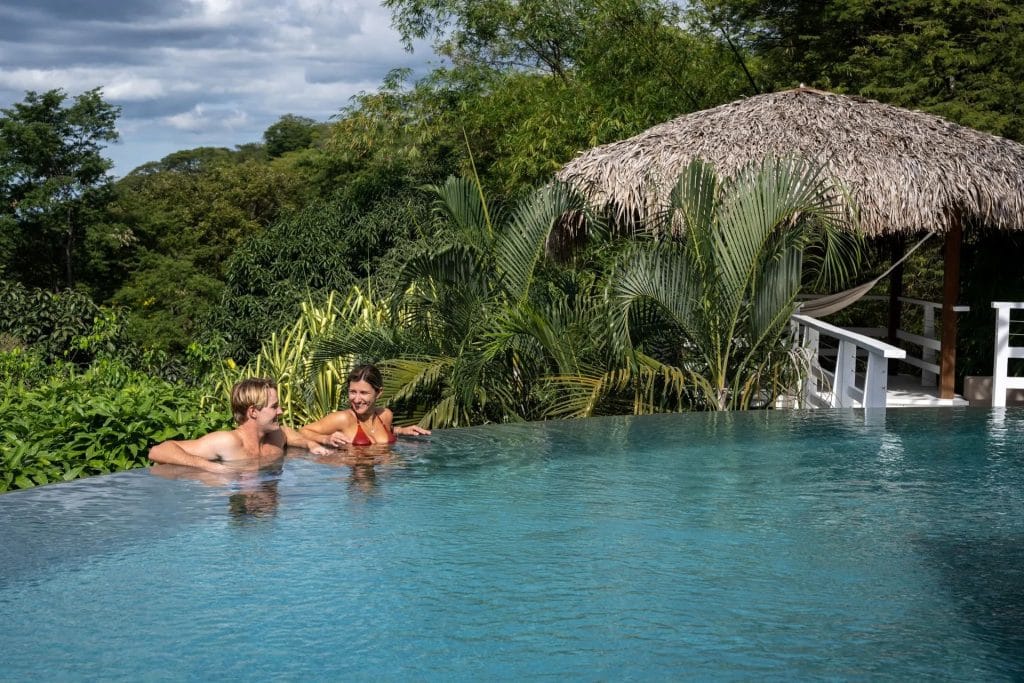
Passive Cooling as a Foundation
For a modern Costa Rica beachfront villa, passive cooling can be one of the most important design choices. In a tropical climate, mechanical cooling is both costly and energy-intensive. Smart design can reduce the need for it, especially when cooling is considered from the earliest planning stage.
Cross-ventilation is central. Homes can be oriented to capture prevailing ocean breezes, with strategically placed openings that allow air to move naturally through interior spaces. High ceilings and ventilated roof structures help dissipate heat, while deep overhangs and shaded terraces limit direct solar gain.
Materials also play a role. Locally appropriate timber, stone, and breathable construction systems can help regulate indoor temperatures more effectively than sealed, concrete-heavy builds. The result is a home that feels cooler without relying as heavily on constant air conditioning. This reflects the broader principles of passive cooling, where building form, shading, ventilation, and material choices work together to improve comfort in hot weather.
Minimal Land Disruption
Another defining principle is minimizing disturbance to the land itself. Instead of leveling plots, better coastal design works around existing topography. This can reduce erosion risk and preserve natural drainage patterns, both of which are critical in coastal environments prone to heavy rainfall.
In some coastal settings, elevated structures can help water move naturally beneath a building during storms. This approach may also reduce the need for extensive foundations and help protect against long-term climate risks, including flooding and sea-level rise.
Construction footprints are becoming more compact as well. Rather than sprawling layouts, newer villas often emphasize efficient use of space, with indoor and outdoor living areas designed to work together. Done well, this can expand functionality without expanding the built area.
Native Landscaping Over Ornamentation
Landscaping is no longer treated as an afterthought or purely decorative element. In sustainable coastal design, it is a core part of environmental integration.
Native plants are prioritized over imported ornamental species. They usually require less water, are better adapted to local pests and weather, and provide more useful habitat for surrounding wildlife. This approach also reduces maintenance needs and lowers the ecological risks associated with invasive or poorly suited vegetation.
Existing vegetation should also be preserved wherever possible. Mature trees provide natural shade, help stabilize soil, and soften the visual boundary between built and natural environments. Research on coastal and riparian vegetation has also shown how vegetated buffers can help reduce land-based impacts on nearby marine ecosystems, including turbidity that can affect seagrass and coral habitat.
The visual outcome is subtle but powerful. Instead of a stark contrast between villa and landscape, the home appears embedded within its surroundings.
Long-Term Environmental Planning
Sustainable design is not limited to the structure itself. Forward-thinking developers are incorporating long-term environmental planning into every stage of the project.
Water management is a key focus. Rainwater harvesting systems, permeable surfaces, and greywater recycling can reduce strain on local resources. Wastewater treatment also deserves close attention, especially near beaches, wetlands, mangroves, and other sensitive coastal or marine areas.
Energy systems are increasingly decentralized. Solar panels, battery storage, and efficient appliances can reduce reliance on external grids. In remote beachfront locations, this is not only an environmental benefit; it can also be a practical necessity.
There is also a growing emphasis on lifecycle thinking. Materials are selected not only for their immediate appearance or performance, but for their durability, maintenance needs, replacement cycles, and eventual environmental cost. A villa designed to last, adapt, and be repaired is often more sustainable than one designed only for visual impact.
A Shift in Value
This new model reflects a broader shift in how value is defined in coastal real estate. The appeal of a Costa Rica beachfront villa is no longer limited to its proximity to the ocean or the drama of its view. Increasingly, it is tied to how well the property coexists with its surroundings.
Buyers are becoming more informed. Energy performance, water use, landscape impact, and resilience are all becoming part of the decision-making process. Developers who ignore these factors risk building properties that may feel outdated, expensive to maintain, or environmentally careless within a few years.
That is not just an ethical issue. As climate pressures increase, properties that work with natural systems may prove more durable than those that try to overpower them.
Building for the Future Coastline
The coastline itself is changing. Sea-level rise, stronger storms, heavier rainfall, and shifting weather patterns are redefining what it means to build near the ocean. Designing with the coastline is not just an ethical choice; it is a practical one.
Resilient architecture anticipates these changes. Flexible design, durable materials, careful siting, and adaptive water and energy systems all help properties remain viable over time. The goal is not permanence at all costs, but longevity through adaptability.
In this context, the Costa Rica beachfront villa becomes more than a luxury asset. It becomes a test of whether high-end coastal living can move away from spectacle and toward stewardship.
The direction is clear. The most compelling villas are no longer those that dominate the view, but those that quietly belong to it.