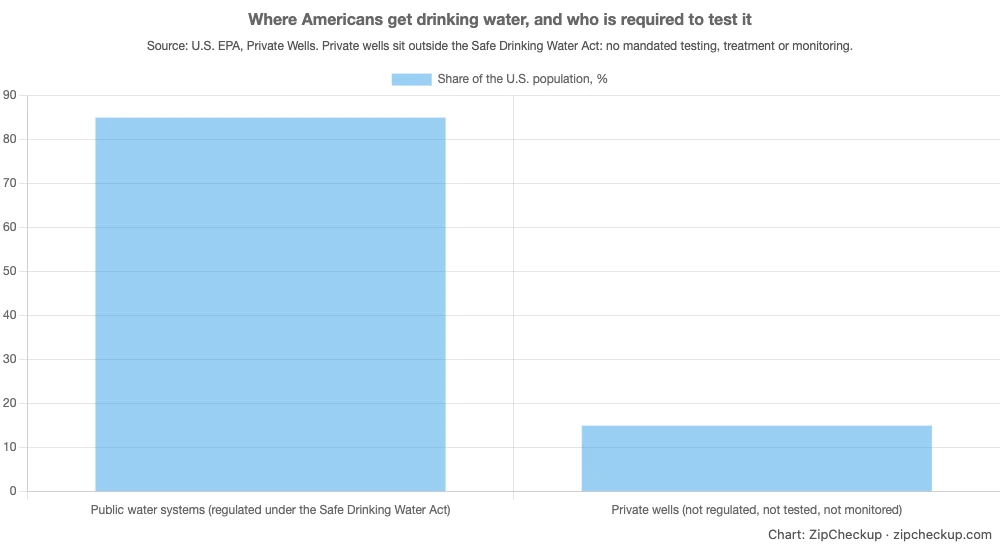
Drinking water in the United States comes in two legal categories: water someone is required to test, and water nobody is. About 15 percent of the population, more than 43 million people, falls into the second group. Federal law puts every public water system on a fixed testing schedule. It reaches nothing at all when the tap draws from a private well. EPA, CDC, and the U.S. Geological Survey describe this arrangement in nearly identical language: the well belongs to the household, and so does the responsibility to test, treat, and monitor it, whether the household knows that or not.
That arrangement predates modern contaminant testing and has not caught up with what a home needs before someone drinks from its tap. Buyers and renters routinely check a home’s roof and electrical panel, but a well’s water quality is rarely part of that inspection unless a state law forces the issue. ZipCheckup’s private well water guide lays out what a household on a private well is and is not responsible for testing, using the same federal guidance cited throughout this article.
Key Takeaways
- More than 43 million Americans, about 15% of the population, drink from private wells outside the Safe Drinking Water Act, per EPA’s page on private wells.
- A USGS study of 2,100 private wells found about one in five contained a contaminant above a human-health benchmark.
- An estimated 2.1 million people use well water with arsenic above 10 µg/L, per Ayotte et al. (2017).
- In a 2024 Iowa study, just 9% of well-owning households had tested their water in the past year, and 40% drank it untested and unfiltered.
- Even where testing is legally required, as in New Jersey since 2002, only about a quarter of the state’s wells have been tested under that law.
A gap by design, not by accident
Federal drinking water law was built around one delivery model: piped water from a utility large enough to justify inspectors, treatment plants, and reporting requirements. Private wells sit outside that model entirely, and the exclusion is explicit, not accidental. EPA states it plainly. Private wells “are not regulated by the Federal Government under the Safe Drinking Water Act nor by most state governments and laws.” The agency adds that “private well owners are responsible for delivering safe drinking water to their households.”
USGS describes the same boundary from the geology side: “the quality and safety of water from domestic wells are not regulated by the Federal Safe Drinking Water Act or, in most cases, by state laws. Instead, individual homeowners are responsible for maintaining their domestic well systems and for monitoring water quality.” CDC gives the consumer-facing version: “tap water from private wells is not regulated, treated, or monitored by officials.” The agency draws the conclusion for the reader. Therefore, you are responsible for making sure your private well water is safe to drink.” CDC also defines the boundary precisely. A system is typically unregulated if it serves no more than 25 people at least 60 days a year and has no more than 15 service connections. A single household well sits well inside that line.
Three agencies, three mandates, the same sentence structure. Not regulated, not treated, not monitored. The household is responsible for the difference (in regulatory terms, a house on a well is its own tiny water utility, without the staff, lab contracts, or reporting duties a real utility carries). Nobody is required to close that gap on the owner’s behalf. In most of the country nobody does.
What testing actually finds
The regulatory gap would matter less if private well water were reliably cleaner than water utilities must test. It is not. EPA cites a USGS study of 2,100 private wells. It found that “water pumped from about one in five wells contained one or more contaminants at a concentration greater than a human-health benchmark for drinking water.” That is a national baseline, not a worst-case outlier, and it applies before anyone has tested their own property.
Arsenic shows up at scale. A 2017 study led by USGS hydrologist Joseph Ayotte, published in Environmental Science & Technology, estimated that “the population in the conterminous U.S. using water from domestic wells with predicted arsenic concentration >10 μg/L is 2.1 M people (95% CI is 1.5 to 2.9M),” the same threshold public systems must meet. Nitrate follows a narrower but sharper pattern: a long-running USGS national monitoring program found “concentrations in about 12 percent of domestic-supply wells in agricultural areas exceeded the U.S. Environmental Protection Agency’s drinking-water standard” of 10 milligrams per liter.
PFAS is where the private-well story stops looking like a special case. A 2023 USGS study led by Kelly Smalling sampled 716 taps nationwide, 269 from private wells and 447 from public supply. It found that “PFAS profiles and estimated median cumulative concentrations were similar among private wells and public-supply tapwater.” Across that combined sample, the study estimated that “at least one PFAS could be detected in about 45% of US drinking-water samples.” Forever chemicals show up in regulated public taps. They show up at a similar rate in wells nobody has to test.
In Focus: Key Data
- 43 million+ Americans, about 15% of the population, rely on private wells; EPA estimates more than 23 million households.
- 1 in 5 of 2,100 sampled private wells exceeded a human-health benchmark for at least one contaminant, per USGS.
- 2.1 million people use well water with arsenic above 10 µg/L (95% CI: 1.5-2.9 million), per Ayotte et al. (2017).
- 45% of 716 tapwater samples nationwide, private wells and public supply combined, had at least one detectable PFAS, per Smalling et al. (2023).
- 9% of surveyed Iowa well-owning households tested their water in the past year; 40% drank untested, unfiltered well water.
- ~25% of New Jersey’s wells have been tested under the state’s 2002 point-of-sale testing law.
Who actually tests
Guidance is not the same as behavior, and the clearest measurement of that gap comes from a 2024 study by Gabriel Lade, an economist at Macalester College, who surveyed well-owning households in Iowa. CDC recommends annual testing for nitrate. Lade found that “just 9% of these households had tested their water quality in the past year.” The share drinking untested water without any backup was larger still: “40% of this group used their wells for drinking water, had not tested it in the past year, and did not filter the water or use other sources such as bottled water.”
Those figures describe Iowa households in Lade’s study sample, not the country as a whole, and should not be read as a national testing rate. What they do show, within that sample, is a wide gap between a standing recommendation and what households actually do. Nobody sends a reminder when a private well’s annual test comes due, no bill arrives if it is skipped, and no inspector follows up. The Iowa numbers describe what happens to a testing recommendation once the organizational pressure that keeps a public utility on schedule is removed and the task is left to a household’s own memory.
What a rule looks like when it exists
New Jersey offers the closest thing to a natural experiment on what happens when point-of-sale testing becomes a legal requirement, not a suggestion. Its Private Well Testing Act has been in effect since September 2002. Sellers or buyers of a property with a private well must test the untreated groundwater for up to 43 parameters, and both parties must review the results before closing. Landlords face a parallel rule, testing wells every five years and sharing results with tenants.
Two decades of that law have not closed the gap, only narrowed it at the margins. The New Jersey Department of Environmental Protection reports that “approximately 25% of the wells in the State have been tested under this Act,” meaning roughly three out of four wells have never been tested under it. The department estimates the average cost of the full panel at “$1,200-$1,500,” a price built for a real-estate transaction, not an annual checkup. A law triggered only at sale reaches households that are buying, selling, or renting, and leaves out anyone who has owned the same well for decades.
What a well owner can do this year
CDC’s standing recommendation is short: “test your well water at least once every year for total coliform bacteria, nitrates, total dissolved solids, and pH level.” It adds that a local health department can say whether volatile organic compounds, lead, arsenic, mercury, radium or pesticides belong on the list too. Penn State Extension puts the cost of that annual bacteria test at “usually costs less than $40,” a fraction of what New Jersey’s full transaction panel runs.
CDC also lists triggers for testing outside that schedule. A notice about well water problems nearby, flooding or land disturbance, any repair to the well system, a change in taste, color or smell, a pregnancy, a new child in the household. After a flood its guidance is direct: “if extensive flooding has occurred or you suspect that the well may be contaminated, do not drink the water.” Disinfection comes with a waiting period, because owners should “wait at least 7-10 days after disinfection, then have the water in your well sampled.” And if the water smells of fuel or chemicals, boiling will not help: “water contaminated with fuel or toxic chemicals will not be made safe by boiling or disinfection.”
Frequently Asked Questions
Is private well water regulated by the EPA? No. EPA states that private wells “are not regulated by the Federal Government under the Safe Drinking Water Act nor by most state governments and laws,” and the owner is responsible for testing and treatment.
How often should a private well be tested? CDC’s guidelines for testing well water recommend testing at least once a year for total coliform bacteria, nitrates, total dissolved solids, and pH, plus testing after flooding, well repairs, or a change in taste, color, or smell.
Is well water safer than public tap water? Not necessarily. A 2023 USGS study found PFAS levels in private wells and public-supply tapwater were similar, and a separate USGS sample found about one in five private wells exceeded a health benchmark for at least one contaminant.
Does every state require testing before a home sale? No. New Jersey requires it under its Private Well Testing Act, but even there, only about a quarter of wells have been tested under the law.
Closing thought
The 43 million people drawing on private wells are handled household by household. There is no shared testing schedule and no agency checking whether one was followed. Federal guidance is detailed, consistent across agencies, and freely available. What it lacks is a mechanism that reaches the household before a well fails, a flood hits, or a home changes hands. New Jersey’s law shows that even a legal mandate closes only part of that distance. Absent a rule, the distance gets closed by memory and occasion, or not at all.
Artem Akulov is the founder of ZipCheckup, a free home-safety report by ZIP code built from EPA, FEMA and Census data.