Mangrove Forests: What are they, why are they so important, and what are their biggest threats?
By Ellen Rubin
Edited by Nina Purton
While there is no precise count for how many trees and shrubs constitute a mangrove forest, the Global Mangrove Watch lists 64 species of mangroves that can live in the intertidal zones between high and low tides.
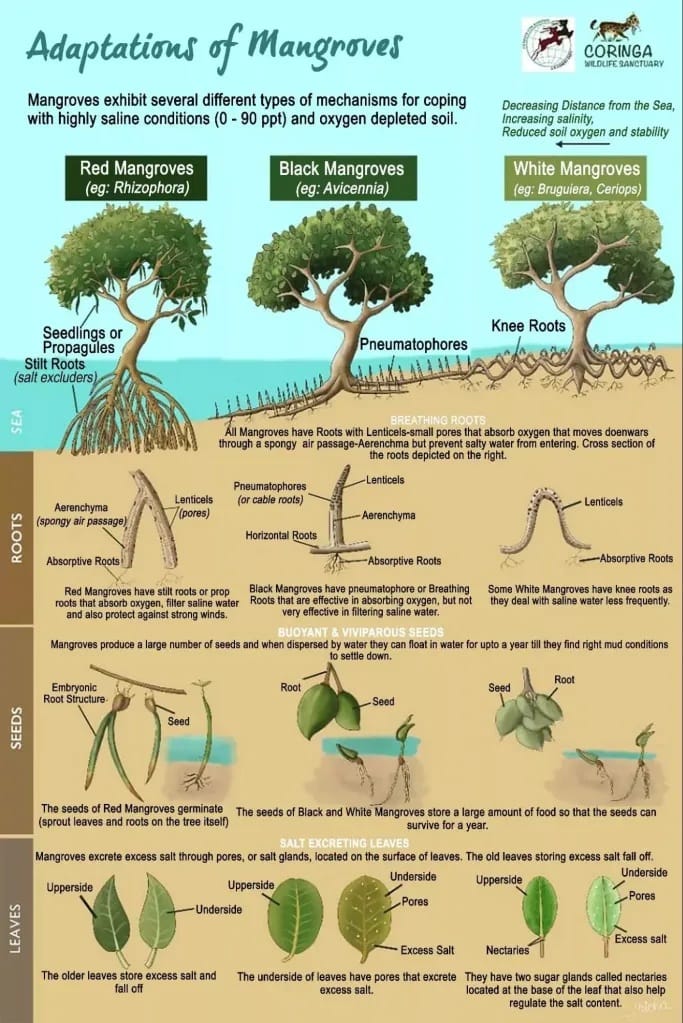
In Puerto Rico, the red, black, and white mangroves each occupy different ecological niches with the red mangroves dominating at lower elevations and the black and white growing in the higher elevations. Having three different species able to grow there allows for diverse ecosystems to flourish.
Mangrove forests do not consist of a single species of plant, but a collection of trees and shrubs that thrive under specific conditions, including:
- Between the interface where fresh and sea water meet to create brackish or saline water.
- Low oxygen, waterlogged soils.
- Tropical and subtropical coastal regions, usually between 25° North and 25° South latitude where there is no chance of freezing temperatures.
It is important to note that some forests have started growing expanding their territory to encroach on temperate wetlands as a result of changing temperatures.
Types of Mangroves

Credit: Pat Josse – Pixabay
There are several types of mangroves and several types of shrubs, palms, ground ferns, vinces and grasses that share the saline swamps with them. Different plants predominate depending on where in the world the mangrove forest is.
Most mangroves in the tropical region are moderately sized, but can exceed expectations in certain locations. The swampy areas around the Gabon Estuary in Africa have mangroves that are more than 200 feet (65 meters) tall and it’s not uncommon to find forests 130 feet (40 meters) tall in places such as Ecuador.
While all mangroves absorve oxygen thanks to their pores (also known as lenticels), their roots grow in different shapes and perform different fuctions.
The most common species are listed below:
Red Mangroves
Rhizophoraceae mangle, or red mangroves, are commonly found in sheltered bays on fringe islands along the tropical coasts of the Atlantic and Gulf of Mexico. While this species can grow up to 80 feet tall most trees will stop at 20-30 feet.
Red mangrove seeds send out long root shoots through the fruit while still attached to the tree. While the shoots reach downwards toward the mud, the fruit either separates to facilitate the root’s descent or starts forming a separate tree while still attached.
As they grow, red mangroves form aerial or prop roots that anchor the tree below the water line. The roots are resilient and great at filtering saline water. These types of mangroves can handle tidal soakings twice a day, even with the sea’s high salinity.
Red mangroves have several benefits:
- The anchored aerial roots slow down waves and allow sediment to settle underneath the trees. This helps mitigate storm surges and eliminate erosion from currents, tides, and waves.
- The high-arching roots are also excellent at absorbing oxygen.
- They are commonly used in forest restoration thanks to rapid growth and resilience.
- They reduce nitrates and other excess nutrients in the water. This makes them a boon for marine life, which is why they are often used in marine aquariums.
Black Mangroves
Unlike the red mangroves, Avicennia nitida or black mangroves reach a maximum height of 70 feet though most are in the 9-40 foot range. Their seeds also fall from the tree before they can propagate.
This species’ roots grow upwards in tube-like structures, also known as pneumatophores. These rise above the waterline and act as a snorkel, facilitating gas exchange. The lower portion of this species’ trunk also has lenticels that further facilitate respiration.
The black mangrove’s small and inconspicuous flowers are discreet yet fragrant. They are also a nutritious food source for honeybees.
White Mangroves
Laguncularia racemosa or white mangroves flourish further inland higher on the land.
Their sprawling root structure provides stability and support and absorb oxygen. The specie also features prop roots that reach up like shoots and the lenticels in its lower trunk that enhance respiration while blocking the salt from entering the tree’s system.
White mangroves can tolerate salt, but grow better alongside less salty water bodies like river banks.
Threats to Mangrove Forests
Every threat to the stabilization of current and future mangrove forests can be traced to humankind. Some activities impact mangrove forest directly (agriculture, coastal development, and overharvesting just to name a few), while others are more subtle (tourism, pollution, and climate change, for example).
If left unchecked and unregulated, our mangrove forests will continue to shrink.
Here are the main reasons why:
Shrimp Farming
The greatest and most direct threat to mangrove forests is shrimp, prawn farming and, to some extent, fish farming. Mangrove forests are perfect breeding grounds for shrimp. Throughout history, this has been a source of income and nutrition for local communities, but the rising global demand has made it a predatory practice.
The rise of commercial aquafarming operations in southeast Asia has transformed a good deal of its wetlands into rectangular ponds and canals. In 2008, 54% of the Mahakam delta in India was dedicated to ponds for shrimp production, according to research.
Because ponds are self-contained, farmers chemically treat and disinfect the ponds, prevent disease by using antibiotics, feed the shrimp with manufactured food pellets, and create a great deal of effluent.
The polluted water leaches into and harms the surrounding environment. When the water becomes too polluted to sustain future operations, the agribusiness merely abandons the toxic site to move further up or down the coast and begins again.
Since the turn of the century, Asia has witnessed a reduction in farms, especially new establishments, and improvements in shrimp farming practices and mangrove protection policies.
Nonetheless, shrimp farming has contributed to the destruction of nearly a quarter of the mangrove forests since 1980. While aquaculture is responsible for 50% of mangrove loss in the Philipines, Myanmar’s Irrawaddy Delta – the country’s largest remaining area of mangrove forest – has lost over 80% of its mangroves since the 1970s through fish or shrimp farming and coastal development.
One way to mitigate the effects of aquaculture is to integrate shrimp farming within the mangrove ecosystem. If the farms are connected to the sea and subjected to the flow of tides, there is less need for antibiotics and disinfectants because of the water flow. You also avoid the need to clear-cut land.
Palm Oil Farming
While the threat of commercial shrimp farming may have slowed in some areas of Asia, the current production of palm oil is 40 times what it was back in 1970. A great deal of the industry’s growth has happened in Thailand, Malaysia, and Indonesia.
Rain forests and mangrove forests are being cut down to make way for these single-crop plantations, affecting biodiversity and counteracting mangroves’ benefits of mitigating soil erosion, climate change, and carbon sequestering.
Community Development
The lure of oceanfront property hasn’t diminished and forests are cleared to make way for new developments. The Tampa Bay, Florida area has lost 44% of their mangroves and marshes in the last 100 years – 20% since the 1980s.
In the past, community threats to mangroves came from overharvesting wood for buildings, the charcoal industry, home fueling needs, fish and seafood for sustenance, and plants for medicines. Today, developments and operations such as dredging or filling the coastline lead to further erosion of the coastline.
Pollution
One of the biggest issues affecting mangrove forests is the pollution from aquaculture and farming activities which include pesticides, herbicides, and insecticides that flow down rivers into the coastline. The release of toxic chemicals, sewage plant refuse, and oil spills have also taken their toll.
It is worth noting that pollution levels worsen when mangroves are removed: the sedimentation is disturbed and trace metals that have settled get stirred up and contaminate the seawater and all the organisms that live in the area.
Tourism
Excessive and indiscriminate tourism results in the disregard for flora and fauna and pollution – especially plastic pollution.
Tourism, successfully managed, doesn’t have to prove a threat to mangroves. Instead, it can be a source of revenue for local communities.
Climate Change
Rising global temperatures and sea levels have contributed to forest destruction. If a forest is undisturbed and sea levels don’t rise precipitously, mangroves can compensate by moving further inland.
While the rise in global temperature has made it possible for mangroves to exist further north and south of 25° latitude, inland regions are largely modified by human development. The demand for space and farms that threaten coastlines is also high.
Invasive Species
Invasive species are a growing problem for mangrove forests.
Several countries have taken the blow:
- Madagascar: a 2023 study of Mongabay, Madagascar found that the number of invasive species expanded from 80 to over 250.
- China: introduced in the late 1970s, marsh grasses are spreading along coastlines, destroying mangrove forests.
- China and Brazil: the Sonneratia apetala tree, native to coastlines along the Indian Ocean and a prolific reproducer, has now been found in these regions. While technically a mangrove tree, it is crowding out native species. “A single tree can bear more than 2,000 apple-like fruits, each containing about 60 seeds”, and those that survive into new trees will monopolize the resources of nutrients, sunlight, and water that native plants need.
Key Takeaways
Although mangroves only occur in tropical coastal areas, their impacts on coastal communities and even inland populations are significant.
Properly managed, mangroves are self-perpetuating. Unfortunately, in the quest for fast money through farming, whether palm oil plantations, shrimp farms, or coast homes with a view, people have not been hesitant to clear-cut mangroves for a profit.
Mangrove loss has a devastating impact, resulting nearly 20% of global emissions from deforestation. The resulting economic damages are equivalent to US$6-42 billion annually.
Mangrove ecosystems are key for climate mitigation, and preservation and result in several economic benefits. Stay tuned for our next article covering the environmental and economic benefits of mangroves in more detail.