Playground safety is often framed as a product problem. Pick the right surface, install the right equipment, follow the checklist, and the job is done. Real playgrounds are messier than that. Safety is shaped by the ground underfoot, the heat of exposed materials, the logic of the layout, the quality of maintenance, and whether children and caregivers can actually move through the space with ease.
That complexity matters because a playground can be technically compliant and still be uncomfortable, exclusionary, poorly maintained, or too hot to use well. It can look modern and still fall short where it counts. If communities want playgrounds that are safer in any meaningful sense, they need to move beyond product claims and think in systems.
Key Takeaways
- Protective surfacing matters because falls remain one of the biggest playground injury risks, but no material solves safety on its own.
- Heat is a serious and often neglected hazard, especially on dark rubber and plastic surfaces in direct sun.
- Accessibility is not separate from safety. A playground that is difficult to navigate is a poorer public space.
- Loose-fill and rubber-based surfaces both have environmental trade-offs, so material choices should be made honestly rather than marketed as simple wins.
- The safest playgrounds are usually the ones that are shaded, visible, drained properly, inspected regularly, and designed for actual long-term use.
In Focus: The 2026 Safety Reality
- The 170°F Threshold: 2026 thermal studies show dark PIP rubber can reach 170°F (77°C), causing contact burns even on mild days.
- Chemical Transparency: The presence of 6PPD-quinone in tire-derived mulch has raised new 2026 concerns regarding chemical runoff into local waterways.
- The Impact Standard: For a surface to be compliant, it must meet ASTM F1292, maintaining a Gmax score under 200 to prevent critical brain injury.
- The Hidden Cost of ‘Soft’: The CPSC warns that synthetic systems can degrade over time, meaning a “safe” installation can fail an impact test in as little as 3 years without maintenance.
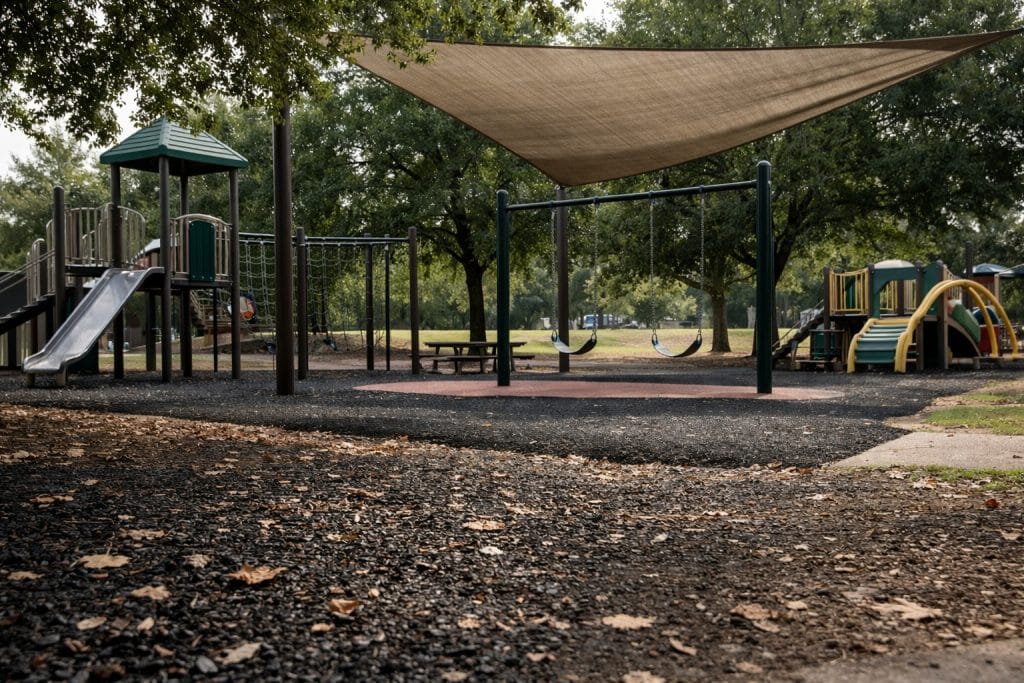
It is tempting to treat the surface under a playground as the whole story. That instinct is understandable. Falls are common, and the difference between a forgiving landing and a hard one matters. But the surface is only one layer of a larger public-space question.
The U.S. Consumer Product Safety Commission makes clear in its public playground safety guidance that hard surfaces such as asphalt and concrete are not appropriate under equipment. From there, the options become less neat. Loose-fill materials can work when they are installed deeply enough and maintained properly. Synthetic systems can work too. Neither category deserves blind faith. Both demand upkeep, and both carry trade-offs.
That is where products like WillyGoat’s rubber mulch for playgrounds tend to attract interest. Rubber mulch is often chosen because it can soften falls, drain reasonably well, and avoid some of the displacement problems that come with bark or wood fibre. In busy public settings, those are not trivial advantages. A surface that stays more consistent between inspections can reduce labour and help keep fall zones usable.
Still, the sustainability case is less straightforward than the marketing usually suggests. Rubber mulch is typically made from recycled tyres, which means it sits in an awkward middle ground: it can be framed as reuse, and sometimes that is fair, but it is also part of a synthetic waste stream with unresolved environmental and health questions. Recycled content is not meaningless. It is just not the same thing as environmental innocence.
Beyond waste diversion, 2026 scrutiny has shifted toward the chemical binders used in these surfaces, with a growing demand for PFAS-free and phthalate-free certifications to ensure that ‘recycled’ doesn’t mean ‘toxic.’
That distinction matters. Too much sustainability language in the built environment relies on a simple trick: it takes one useful feature and inflates it into a moral conclusion. A material diverts waste, therefore it is sustainable. A surface lasts longer, therefore it is environmentally superior. Real life is rarely so tidy. As we noted in our examination of artificial turf and its environmental trade-offs, synthetic durability can solve one problem while deepening another.
For tyre-derived playground materials, the uncomfortable question is not whether reuse is better than landfill in the abstract. It is whether the full balance of impact makes sense for a particular site. How hot does the surface become in summer? How does it age? What happens when fragments break loose? What does end-of-life disposal look like? What alternatives were realistically available? Those are harder questions than a product brochure wants to ask, but they are the ones that matter.
Heat changes the conversation
One of the clearest weaknesses in playground discussions is how often they treat impact protection as the only real safety issue. It is not. Heat can shape whether a playground is usable at all.
The CPSC has warned that plastic and rubber surfaces can become hot enough to burn children. Research on outdoor play environments has reached similar conclusions, with dark synthetic surfaces repeatedly emerging as some of the hottest materials in exposed conditions. That means a surface selected for one kind of protection can create a different kind of risk if the wider design is careless.
This is one reason shade deserves to be treated as core infrastructure rather than an optional extra. A playground without adequate shade may still look complete on paper, but in practice it can become hostile for hours at a time. Trees help. Shade structures help. Orientation helps. Material colour helps. None of these decisions are decorative. They shape whether children can use the space safely and comfortably in ordinary weather.
The same is true of drainage. A fall zone that stays wet, slippery, muddy, or uneven after rain is not doing its job. Water pooling shortens the life of materials, complicates maintenance, and makes accessibility worse. Good drainage rarely appears in the glamorous part of a project brief, but it is one of the quiet choices that determines whether a playground continues to function well after the ribbon-cutting photos are over.
Then there is visibility. Playgrounds work better when adults can supervise naturally, without needing to patrol blind corners or guess what is happening behind oversized structures. Sightlines affect how quickly problems are spotted and how confidently younger children are supported. A space can be playful without being visually chaotic. In fact, the best-designed ones usually are.
Accessibility is part of the safety brief
Too often, accessibility is treated as a parallel concern rather than a central one. A ramp is added here, a transfer point there, and the project congratulates itself for being inclusive. But accessibility shapes the whole experience of a public space. It affects who can enter, who can move independently, who can accompany a child without strain, and who ends up excluded by friction that should never have been designed in.
The U.S. Access Board’s guidance on play areas makes that explicit. Accessible routes, surface stability, and connections between play components are not decorative compliance details. They are part of whether the space works as public infrastructure.
This is where playground design becomes more interesting, and more ethically demanding. Some lower-synthetic materials may appear environmentally preferable at first glance, yet be harder to navigate consistently over time. Some synthetic systems may improve access while raising other environmental concerns. The task is not to pretend those tensions do not exist. The task is to design with them openly.
A safer playground is one where a wider range of children can move, play, pause, and return with dignity. That should not be treated as a bonus feature. It is part of what safety means.
The real test comes later
Most playgrounds are safest on the day they open. The real story begins after weather, wear, sunlight, neglect, and heavy use have had time to settle in.
That is why maintenance matters more than many product comparisons admit. Loose-fill surfaces migrate and need topping up. Timber components weather. Fasteners loosen. Drainage fails. Synthetic materials can heat up, fragment, or age in ways that were not obvious in the sales images. Every system asks something of the people responsible for it.
The strongest playgrounds are usually not the ones with the most polished specification sheets. They are the ones matched to real maintenance capacity. They are inspected regularly, repaired promptly, and designed with enough humility to acknowledge that public spaces do not stay pristine on their own.
That also means communities should be sceptical of any material pitched as a silver bullet. “Low maintenance” is not the same as maintenance-free. “Recycled” is not the same as harmless. “Natural” is not the same as safe. Once those easy labels are stripped away, better decisions become possible.
So what actually makes a playground safer? Not one miracle surface. Not one buzzword. Not one procurement choice dressed up as sustainability.
Safer playgrounds tend to share a different set of traits. They are forgiving where children are likely to fall. They are shaded where heat would otherwise become a hazard. They drain properly. They are easy to supervise. They remain usable for children with different bodies and needs. And they are maintained as though somebody understands that public infrastructure is only as good as the care that follows installation.
That may be less exciting than a sleek promise about eco-friendly materials. It is also far closer to the truth.
Sources & Further Reading
- U.S. Consumer Product Safety Commission — Public Playground Safety Checklist
- U.S. Consumer Product Safety Commission — Public Playground Safety Handbook
- U.S. Consumer Product Safety Commission — Thermal Burns from Playground Equipment
- U.S. Access Board — Chapter 10: Play Areas
- NRPA — The Daily Dozen: 12-Point Playground Safety Checklist
- Building and Environment — Outdoor playgrounds and climate change